
Understanding Garfield County Releases
“Released” means that one agency's custody ended. It does not always mean the person walked into the community with no further legal control. An ordinary Garfield County detainee may leave after posting bond, receiving a court order, completing time served, or having a case dismissed. A state prisoner may leave prison on parole but remain under Utah Department of Corrections control. Someone transferred from Garfield County Jail to another jail, UDC, a federal authority, or immigration custody has changed locations rather than gained release.
The source that proves the event depends on who held the person. The Garfield County Sheriff's Office creates the local booking and release record. Utah courts preserve the case orders and outcome. UDC records state custody, parole, probation, and sentence dates. Federal agencies keep their own custody records. A name vanishing from a current jail roster is only a clue. The durable proof is a record that identifies the releasing agency, departure time, and release type or transfer authority.
- Release
- The end of custody by a particular agency.
- Transfer
- A move to another custodian while confinement continues.
- Parole
- Conditional release from prison under community supervision.
- Probation
- Court-ordered community supervision that may follow jail or replace prison.
- Discharge
- The end of the sentence or supervision term, not merely departure from a facility.
Garfield County Release Types
The end of a Garfield County custody event is best read as a route, not a single label. Bond or release on recognizance returns a local detainee to the community while the case may continue. Time served means the required jail term has been credited or completed. Dismissal ends the charge addressed by that order, though another hold may still prevent departure. Probation can follow jail or be imposed without state-prison release.
| Release type | What it means | Where to verify next |
|---|---|---|
| Bond or court release | Local custody ends while the case may remain open. | Sheriff release record and court docket. |
| Time served | The court-recognized county term is complete. | Jail record and sentencing entry. |
| Probation | The person is under a community court order. | Court and UDC search when UDC supervises. |
| Parole | Prison ends but state supervision continues. | UDC status and Board decision. |
| Transfer | The person remains in another agency's custody. | Receiving jail, UDC, BOP, ICE, or court. |
| Expiration or termination | The controlling state sentence ends. | UDC record, Board decision, and court history. |
A detainer is a request by another authority to hold or take custody of a person. It can block a planned community release. An order allowing release and the actual departure can therefore have different timestamps. Ask the sheriff to distinguish release from transfer.
Garfield County Release Record Fields
Garfield County does not publish an official field-by-field online release feed. A focused request should name the fields needed from the existing booking and release record. Some entries may be withheld or redacted under Utah law, and the sheriff does not have to create a new summary. This inventory reflects useful fields, not a promise that each record has them all.
| Field to request | What it can establish |
|---|---|
| Full name and identifiers | Links the event to the correct person. |
| Booking or SO number | Connects release to the right booking. |
| Booking date and time | Marks the start of local custody. |
| Release date and time | Shows when Garfield custody ended. |
| Release type or authority | Distinguishes bond, time served, court action, or transfer. |
| Charge and court case | Points to the docket explaining the legal basis. |
| Receiving authority | May separate community release from transfer. |
UDC uses different fields. Its public information includes legal status, housing, sentence, Board hearing information, sentencing case, and “Parole/Expiration Date.” Read them together. “Parolee” plus a parole date supports prison release into supervision, not full discharge. A hearing date is only a review date.
Request Garfield County Release Records
Use the Garfield County Sheriff GRAMA instructions for a local booking. GRAMA is Utah's Government Records Access and Management Act. It permits requests for existing public records, but it does not require an office to answer questions or create a custom report.
- Identify the person by full name, birth date if known, and rough booking date. Add the booking number when available.
- Ask for the booking and release record, departure date and time, release type or authority, charge, case number, and transfer field.
- Request electronic delivery and an estimate before chargeable work begins.
- Email the official form to Tom.Talbot@garfield.utah.gov or return it to the form address.
- Review the reply for released fields, redactions, cited denial, estimate, or notice that no record is held.
Black-and-white copies cost $10 for the first ten pages and $0.25 for later pages; color copies are $0.50 per page. Search, retrieval, and direct administrative cost may apply. Full estimated payment can be due before work. The office states that it has up to ten business days to respond. A response deadline does not promise production.
Utah Law on Garfield Releases
Utah Code § 63G-2-201 states that a government record is public unless another law provides otherwise. The agency must make a reasonable search. It need not create, compile, or reformat data. Private, protected, controlled, juvenile, sealed, and expunged material can be limited. Public portions may remain available after exempt details are removed.
An expungement order seals or restricts eligible records. A Bureau of Criminal Identification eligibility certificate is not the order itself. Once an agency receives a signed order, later public searches may no longer show the case. That absence means the public route cannot verify it.
Garfield Release Form Address
The official sources contain a mailing detail worth checking. The GRAMA form says P.O. Box 375, while the jail page says P.O. Box 370. Use the box printed on the form for that form, then call 435-676-2678 when delivery time matters. Both sources use 375 North 700 West in Panguitch as the physical address.
Emailing the form avoids the mailbox question. Keep a copy of the request, estimate, and response so the scope and timeline remain clear.
Note: Box 375 is the documented form address, but a phone check is prudent because the jail page lists Box 370.
Property After a Garfield Release
The sheriff has a separate personal-property process for evidence no longer needed, safekeeping items, and found property held more than 90 days. It names Sgt. Tom Talbot at 435-676-1126 and cites § 77-11d-105. This is not described as the routine rule for every person leaving jail.
Call Garfield County Jail first about ordinary booking property. Use the unclaimed channel only if staff says it applies. Evidence, safekeeping items, and booking property may follow different rules.
The sheriff's source page shows the limited scope of that route.
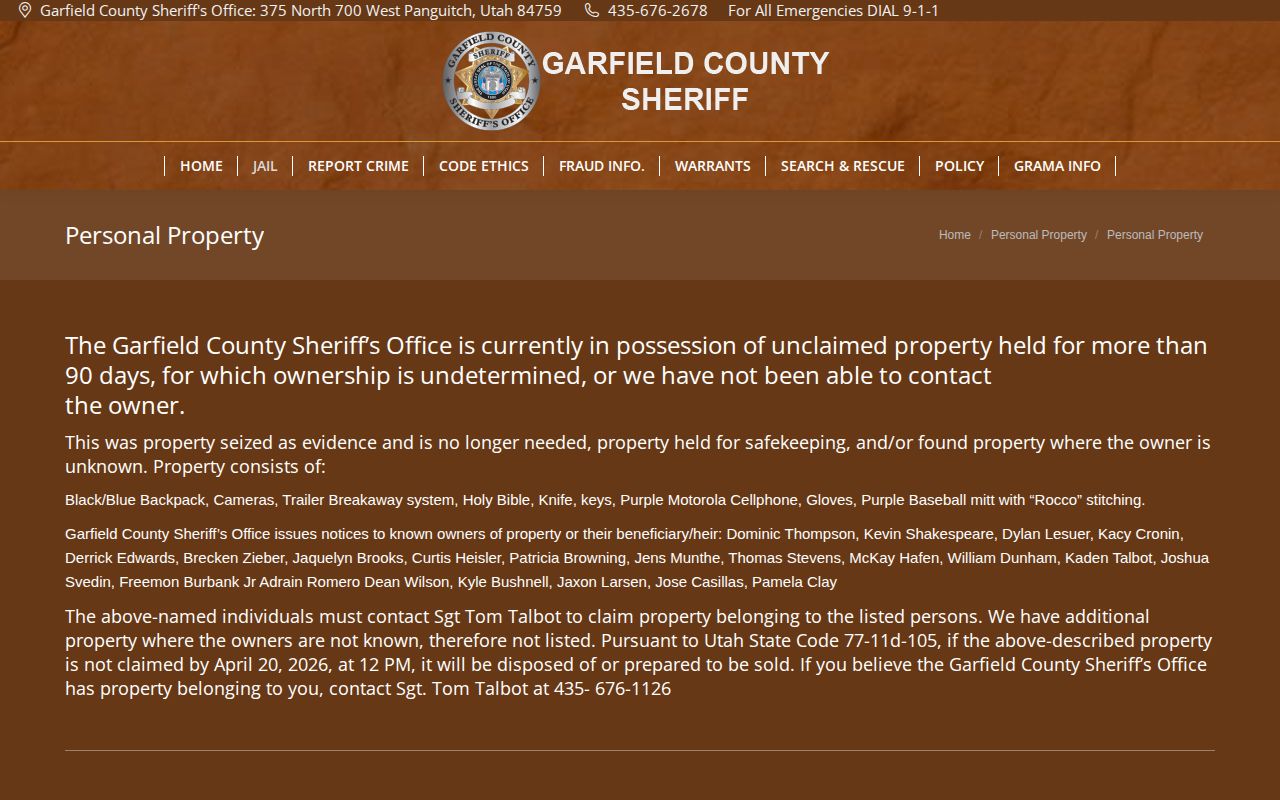
Its headings concern evidence, safekeeping, and found property, so jail staff should first identify the right channel.
Find a Garfield Released Inmate
Start with the legal custodian, not a broad name search. Garfield County has no verified official release feed. The correct route moves from sheriff records to state or federal sources only when the facts support it. Save the exact status words and dates from each source.
- Call Garfield County Jail and ask if the person is now in local custody. If not, ask whether staff can distinguish community release from transfer.
- Request the Garfield booking and release record for durable proof.
- Search UDC when a state sentence, state contract bed, parole, or probation may apply.
- Search the Utah Board decision tool and the correct district or justice court.
- Try VINE for custody events, while treating silence as inconclusive.
- Use BOP, USMS and federal court, or ICE only when that authority is involved.
The Garfield County 24-Hour Release List explains the same-day fallback when no county feed exists. For one known name, combine the jail call, release record, and correct outside system.
UDC Search for Garfield Releases
The Utah Department of Corrections Offender Search covers people currently under UDC supervision, including inmates, parolees, and probationers. It excludes people awaiting trial or not yet sentenced in a county jail. A fully discharged person may no longer appear, so a negative result proves little.
| Search item | How to use it |
|---|---|
| UDC number | Use first when known because it is precise. |
| First and last name | Enter at least one letter of each and compare identifiers. |
| Date of birth | Reduce same-name mistakes. |
| Legal status and housing | Distinguish parole, probation, prison, and contract placement. |
| Parole/Expiration Date | Use Utah's official date term, not proof a future event occurred. |
| Sentencing case | Match the court and Board records. |
The official screen displays the scope warning and fields. Review the UDC search source before interpreting a result.
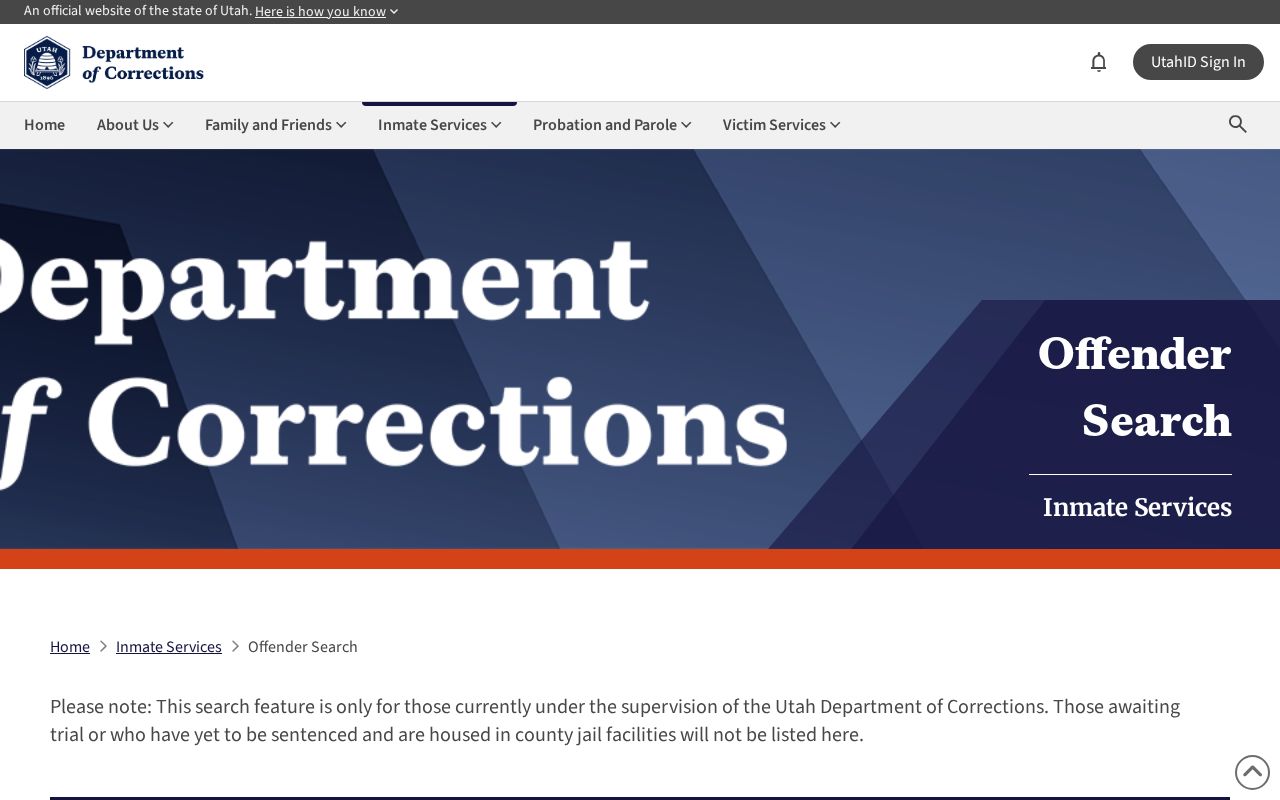
“Parolee” supports prison release into supervision. “Inmate” with county-jail housing can still mean state custody.
Garfield County Recent Releases
The official Garfield County Jail page provides contact details but no current inmate table, booking log, release archive, or date filter. No official 24-hour or 72-hour view was found. A former sheriff booking address returned 404 during research and cannot be called a working roster.
No verified sheriff mobile app or official social account acts as a release archive. NCIC is named for inmate messaging and mail, not a public release list. Use an immediate phone check followed by a GRAMA request. With no feed, fields, cadence, retention, and photo policy cannot be inferred.
The official page screenshot confirms its focus on jail contacts. Check the live Garfield County Jail page.
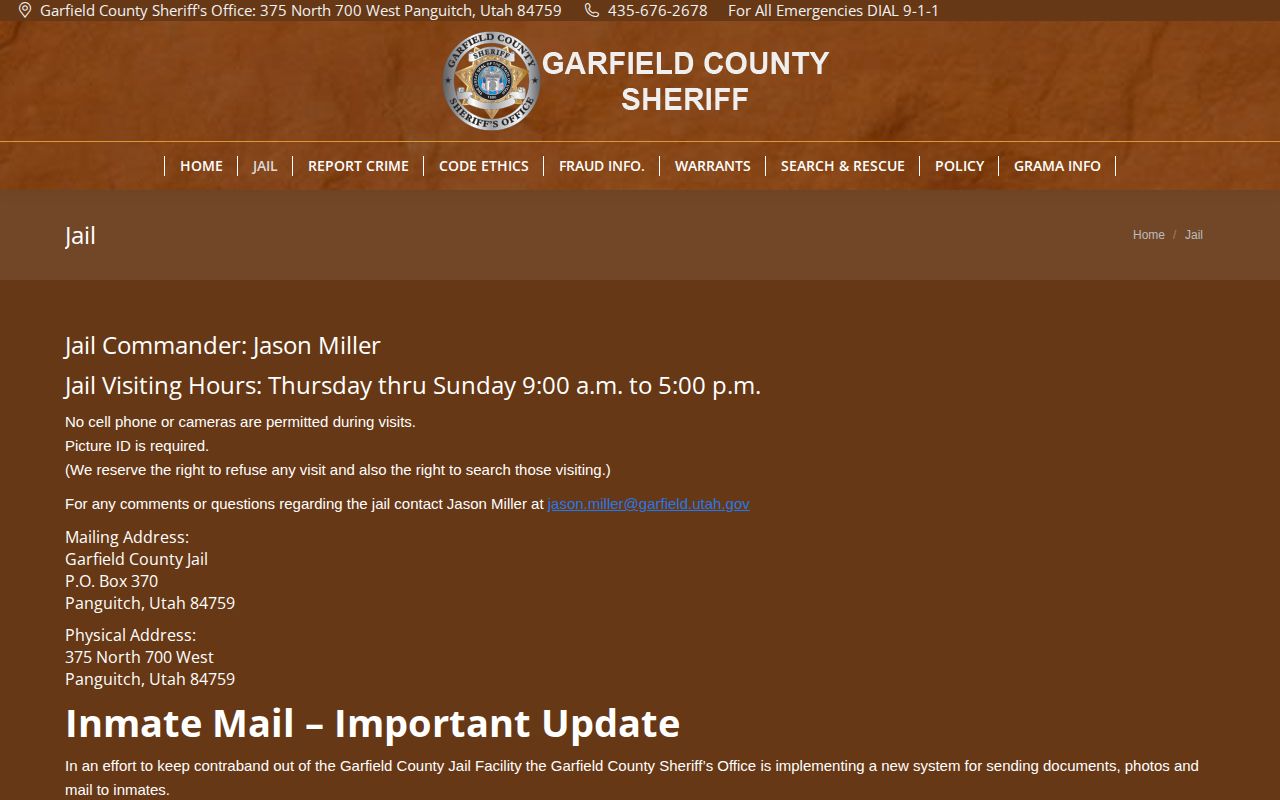
Its lack of a release tab supports using the sheriff's records process instead of an unofficial substitute.
Garfield Releases or UDC Transfers
Garfield County Jail has a role that makes a missing local name hard to read. UDC's April 2025 report lists 114 total beds and 96 contracted beds available for Corrections prisoners. Someone can be housed in Panguitch while the state remains the legal custodian.
The UDC Release Day information says almost all state prisoners housed in contract county jails go to Utah State Correctional Facility for release. Direct county-jail release is extremely rare. Leaving Garfield can therefore be a move to USCF, not a community release.
Check the jail departure against UDC status and the Board order. County records show the physical exit. State records show whether UDC custody ended.
Garfield Supervision After Release
Parole follows prison release by Board authority. Probation is imposed by a court and may follow county jail or avoid prison. Both can involve reporting, residence rules, treatment, travel limits, curfew, restitution, community service, and a case plan. Neither means the sentence has fully ended.
Use UDC Offender Search for public legal status, then call Adult Probation and Parole to confirm the unit. UDC lists Garfield County in both Richfield and Cedar City entries, an unexplained overlap. Both offices must remain in the verification path until AP&P confirms the assignment.
“Absconded” means alleged failure to remain under supervision. It is not a new conviction or discharge. No official statewide AP&P absconder list was found, so use direct agency and official warrant confirmation.
Garfield Release Reentry Programs
UDC's jail report lists the 42-seat Dare to Soar intensive outpatient program and After Care. It records 63 successful Dare to Soar transitions in fiscal year 2024 and 11 high-school or completion diplomas.
Other offerings include relapse prevention, life skills, parenting, Success After Prison, criminal-thinking work, and substance-use intervention. These are reported programs, not universal services or proof that a named person participated.
Participation does not replace a release record. It can explain transition context, while sheriff, UDC, Board, and court sources establish the legal status.
Garfield Release Alerts and Federal Records
Utah VINE, reached through VINELink or 1-877-884-8463, provides custody details and event alerts for Utah prisons and jails. Official sources support release, transfer, escape, and death events, plus selected UDC moves and parole-date notices. A transfer means custody continues. No reviewed participant list names Garfield County Jail, so confirm a local event with the sheriff.
Federal custody uses separate tools. The BOP Inmate Locator covers federal inmates from 1982 forward and may show a release date plus “Released” or “Not in BOP Custody.” That ends BOP custody only. Federal pretrial defendants may be held under U.S. Marshals authority in local facilities, making federal court and the holding agency more useful.
ICE's locator covers current immigration detainees and people released from ICE custody within the last 60 days, subject to stated limits. A Garfield handoff to ICE is a transfer. No-result does not prove community release.
Garfield Courts After Release
Three court identities share the Panguitch courthouse. Sixth District Court handles felonies and class A misdemeanors. Garfield County Justice Court handles many class B and C matters filed by the sheriff, Highway Patrol, or wildlife officers. Panguitch City Justice Court is separately named despite sharing the county justice clerk.
Utah Courts Xchange can show parties, hearings, judgments, documents, and completed outcomes. Search by case number first, or narrow a name by birth date, county, court, case type, or date. Coverage says Panguitch district cases filed from February 24, 2000 are complete; older converted data may be thin.
A court order can dismiss a charge, impose probation, grant time served, or authorize release. Jail staff still process departure. Compare the order with the sheriff record. Sealed, expunged, juvenile, and other nonpublic cases do not appear.
Where Garfield Release Records Remain
Each source answers a narrow question. Use the route matching the legal custodian, then corroborate the event.
| Source | Strongest use | Cannot prove alone |
|---|---|---|
| Garfield County Jail | Present local custody and local release record. | End of another agency's custody. |
| UDC search | Current Utah inmate, parolee, or probationer status. | Historical discharge or pretrial county status. |
| Board search | Parole orders, rehearings, and terminations. | Exact physical departure. |
| Utah Courts | Case action, sentence, probation, or dismissal. | Jail processing time. |
| VINE | Custody events and alerts. | A certified historic ledger. |
| BOP or ICE | End of that federal or immigration custody. | Release from every authority. |
Question: Why can someone vanish from every current search? Live tools track current custody or supervision. After discharge, the lasting trail may be the sheriff record, prior Board decision, and court case.
Garfield County Release Facility
The official-source sweep identified one county detention facility: Garfield County Jail. It holds local detainees and county prisoners and has contract beds for UDC prisoners. Custody authority matters more than the building name.
- Garfield County Jail: local releases may lead to the community after bond, dismissal, time served, or court action; state-contract departures commonly lead to another UDC placement before release.
No separate municipal jail, state prison, federal prison, or officially identified ICE detention facility in the county was found. Outside systems can still hold people whose cases began here. The correct locator follows the custodian, not the county boundary.